
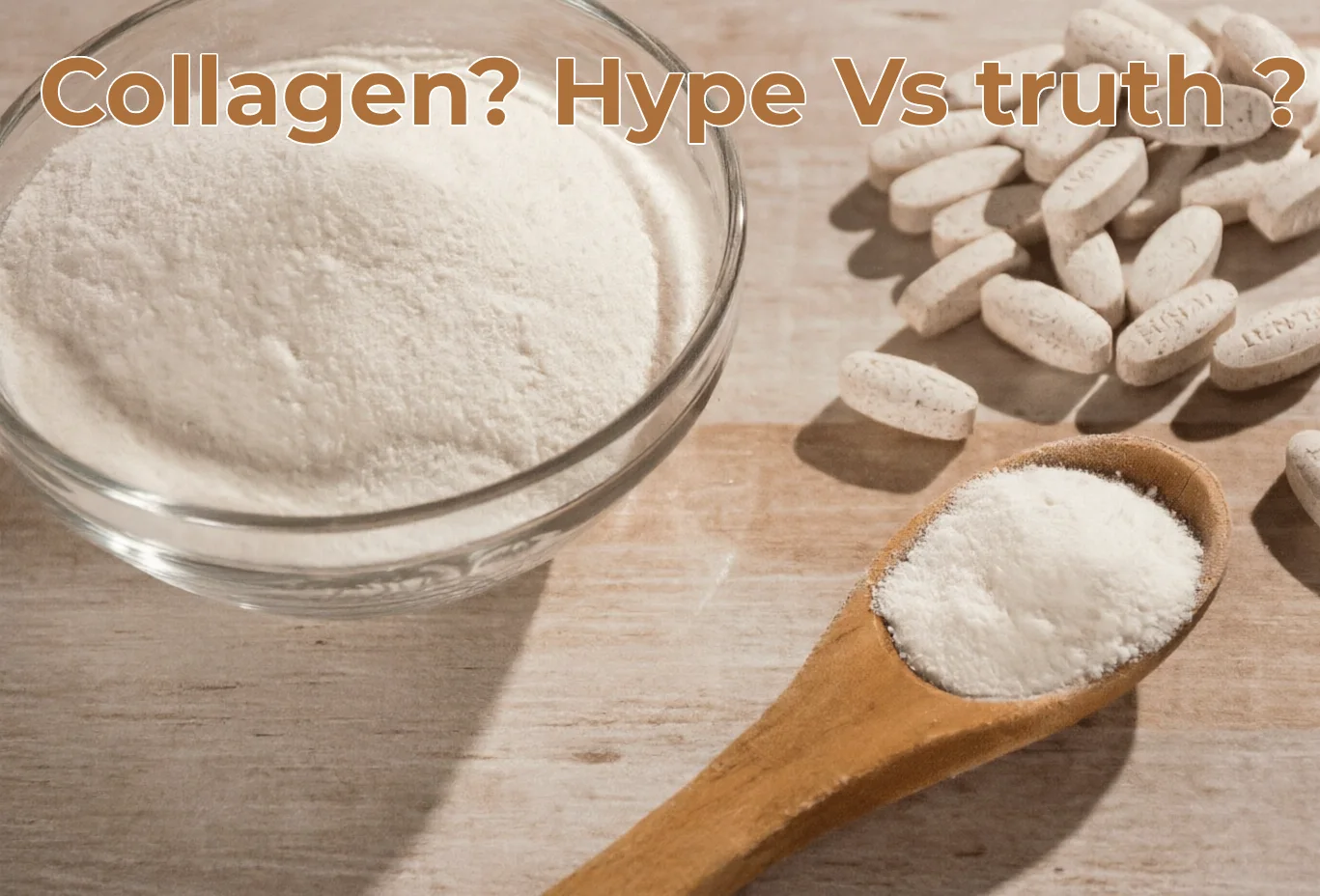
If you follow modern Skin care even a little bit – you must have heard about Collagen. A patient walked into my clinic last month holding three different collagen tubs. One peptide powder. One gummy bottle, still in its Amazon packaging. And one “marine collagen” sachet her cousin had sent from Korea. She’d been taking all three at the same time for about six weeks, and her question was simple: “Doctor, which one is actually working?”
I had to tell her something that doesn’t sell well on Instagram. Probably none of them, at least not the way she’d been promised.
Collagen supplements are one of the fastest-growing categories in Indian wellness retail right now. Walk into any pharmacy in Delhi and you’ll find shelves of it. Powders, gummies, sachets, even collagen-infused chocolate.
I want to be clear about something before we go further. I am not here to tell you collagen supplements are a scam. That would be dishonest. But the gap between what the research shows and what the marketing implies is wide enough to drive a truck through, and I think you deserve to know exactly where that gap sits before you spend your money.
What Collagen Actually Does in Your Skin
Collagen is the structural protein that keeps your skin firm, your joints cushioned, and your tendons strong. In the skin it sits in the dermis, woven together with elastin to create that plump, bouncy quality we associate with young skin.
Your body starts reducing collagen production somewhere around your mid-20s, and for women the decline speeds up after menopause. Research on chronologically aged skin has traced this to age-dependent changes in fibroblast function combined with reduced mechanical stimulation of the skin over time. This research by National Library of Medicien Us often gets cited repeatedly across the collagen-supplement literature. Sun exposure, smoking, high sugar intake and pollution all accelerate the decline considerably. And Delhi’s air quality is not helping. I’ve gone into this in more depth in my piece on aging in Indian skin.
So the premise itself, that collagen matters and declines over time, is solid biology. The real question is whether swallowing it replaces what your skin is losing.
The Digestion Problem: Why “Eating Collagen” Isn’t That Simple
When you swallow a collagen supplement, it does not travel to your face and slot itself into your skin like a jigsaw piece. It goes into your stomach, where digestive enzymes break it into peptides and eventually amino acids. Same as any other protein, whether it came from dal, paneer, or chicken.
This is the core argument skeptics make and it is not wrong. Your body does not distinguish between an amino acid from an expensive marine sachet and one from your breakfast eggs. So why do trials keep showing measurable effects anyway? Two mechanisms have decent research support.
The first is bioactive peptides. Hydrolyzed collagen contains small peptide fragments, prolyl-hydroxyproline being the best studied, that appear to survive digestion intact enough to enter circulation and act as signaling molecules. They prompt your fibroblasts to increase their own collagen output rather than becoming skin directly. Studies have shown that daily peptide intake can decrease expression of matrix metalloproteinases, the enzymes responsible for collagen breakdown, while enhancing fibroblast growth. A 2024 paper in the Journal of Clinical Medicine reviewed this mechanism in detail.
The second is simpler. Amino acid supply. Collagen is unusually rich in glycine, proline and hydroxyproline, and these are harder to get in adequate amounts from a typical vegetarian Indian diet built around dal and dairy rather than connective-tissue-rich cuts. Supplementing may simply top up raw materials you were mildly short on.
Neither theory explains the full picture on its own. The truth is a more nuanced story than “you eat collagen, you get collagen.” It is also a more nuanced story than pure marketing fiction.
What the Clinical Research Actually Shows
This is where precision matters, because “studies show collagen works” and “studies show modest improvement in specific measured outcomes under specific conditions” are very different claims that get flattened into the same marketing line.
The evidence base is now fairly large. A meta-analysis of 26 randomized controlled trials covering 1,721 participants, published in Nutrients in 2023 and indexed on PubMed Central, found that hydrolyzed collagen significantly improved skin hydration and elasticity compared with placebo, with strong statistical significance on both measures. A separate meta-analysis on PubMed (PMID 33742704) concluded that around 90 days of hydrolyzed collagen intake reduces wrinkles and improves elasticity and hydration. A more recent systematic review in the European Journal of Clinical Nutrition (2026) covered 25 RCTs with sample sizes ranging from 13 to 236 participants and confirmed the direction of these findings, though it flagged that the clinical evidence remains inconsistent across trials. And a 2025 meta-analysis in The American Journal of Medicine, covering 23 RCTs and nearly 1,500 participants, again found significant improvements in hydration, elasticity and wrinkles. But it noted something interesting. The effect shrank in subgroup analysis by funding source.
That last point matters more than most people realize. A few honest caveats I give every patient:
The effect sizes are small and gradual. We are talking incremental improvements measured by specialized skin-imaging instruments over 8 to 12 weeks. Not the dramatic, camera-ready transformation implied by before-and-after ad photos, which are almost always aided by lighting, makeup, and sometimes actual filters.
Industry funding shapes the literature. Several reviews explicitly flag that funding source correlates with the size of the reported benefit. This doesn’t invalidate the science. But it does mean independent replication deserves more weight than sponsor-funded trials.
And study populations skew East Asian and European. There is limited data specifically on Indian skin, which matters more than people assume, given how differently Indian skin ages compared with lighter Fitzpatrick types.
If you want to read the primary literature yourself, the 2023 Nutrients meta-analysis is open-access on PubMed Central, and the PubMed-indexed 2021 review (PMID 33742704) is a good second reference point.
So, does oral collagen do something? Probably yes. Modestly, for some people, with consistent long-term use. Does it do what the packaging implies? Almost certainly not.
Marine vs. Bovine vs. Plant-Based: Does the Source Matter?
Marine collagen, which comes from fish skin and scales, tends to have smaller peptide particle size. Theoretically that improves absorption, though the Nutrients meta-analysis found no statistically significant difference in elasticity outcomes between sources (p = 0.21). Worth knowing before you pay the marine premium.
Bovine collagen, from cow hide and bone, is the most widely studied and the most common in the Indian market. It is generally rich in Type I and Type III collagen, the types most relevant to skin.
Now, “plant-based collagen” needs some honesty applied to it. Plants do not contain collagen. It is an animal protein, full stop. What these products actually contain are compounds like silica, vitamin C and amino acid blends marketed as supporting your body’s own collagen synthesis. That is not necessarily useless, since vitamin C is a genuinely essential cofactor for collagen synthesis. But calling it “plant collagen” is a stretch bordering on misleading. It sits in the same category as the claims I cover in my article on the biggest skincare scams in India.
I’ve broken this comparison down in much more detail, including the hydrolysis-quality nuance most brands don’t mention, in my dedicated article on Marine vs. Bovine vs. Plant-Based Collagen: Does the Source Actually Matter?
What Actually Moves the Needle More Than Supplements
If you’ve read my scams article, you know I have a habit of being the person who says “actually, sunscreen matters more.” I’m going to do it again.
Sun protection remains the single highest-leverage intervention. UV exposure activates matrix metalloproteinases that actively break down your existing collagen. This is the dominant driver of premature skin aging, and it outweighs anything a supplement adds back by a wide margin. A ₹500 sunscreen used consistently will do more for your long-term collagen levels than a ₹3,000 monthly supplement subscription used inconsistently. I go into the regional specifics in Surviving Delhi: 7 Skincare Tips for the Heat and Pollution.
Retinoids deserve their own mention. I’ve covered them extensively in my retinol vs. retinoids vs. tretinoin guide, and the short version is this: they have some of the strongest clinical evidence of any topical intervention for directly stimulating dermal collagen production, with decades of research behind them.
Then there are professional treatments. Microneedling and certain lasers create controlled micro-injury that triggers your skin’s own collagen remodeling. I discuss the trade-offs in my chemical peels vs. laser treatments article. These tend to show more visible, measurable results than oral supplementation alone.
What I Actually Tell Patients
If a patient wants to try collagen supplementation, I don’t discourage it outright. The risk profile is low for most healthy adults and there is genuine, if modest, evidence behind it. But I set expectations honestly.
Use hydrolyzed collagen peptides specifically. That’s where the research is strongest. Expect to wait at least 8 to 12 weeks of consistent daily use before judging any effect, and even then, expect subtle improvement, not transformation. Don’t drop your sunscreen or retinoid routine because you’ve added a supplement. Collagen is, at best, a supporting player. And if you have kidney disease or a metabolic condition, check with your physician before adding any high-protein supplement.
For most of my patients, honestly, I’d rather see that budget go toward a good broad-spectrum sunscreen and a properly introduced retinoid. Interventions with a much larger and better-established evidence base.
The Uncomfortable Truth
Collagen supplements occupy a strange, honest-ish middle ground in a market full of extremes. Not a scam. Not the transformation-in-a-jar story they’re sold as either. The clinical evidence, drawn from dozens of peer-reviewed trials on PubMed and in journals like Nutrients and the American Journal of Medicine, shows real benefit. Real, but modest. The marketing takes that modest reality and inflates it into something closer to a fountain of youth.
You’re allowed to try it. Just try it alongside the interventions that actually have the strongest evidence behind them, not instead of them. And if you’d like a skincare routine built around what the evidence actually supports rather than what’s trending this month, that’s exactly the kind of conversation we have during a consultation.
Dr. Shruti Patil is a board-certified dermatologist and cosmetologist at Dr. Mahajan Skin To Bone Clinic, Pashim Vihar, New Delhi. She has a particular interest in separating evidence-based skincare from wellness marketing trends, especially as they reach Indian patients through social media.
Curious whether collagen supplementation makes sense for your skin, or want a routine built on stronger evidence? Book an appointment with Dr. Mahajan’s Clinic for a personalized consultation.
Leave a Reply