
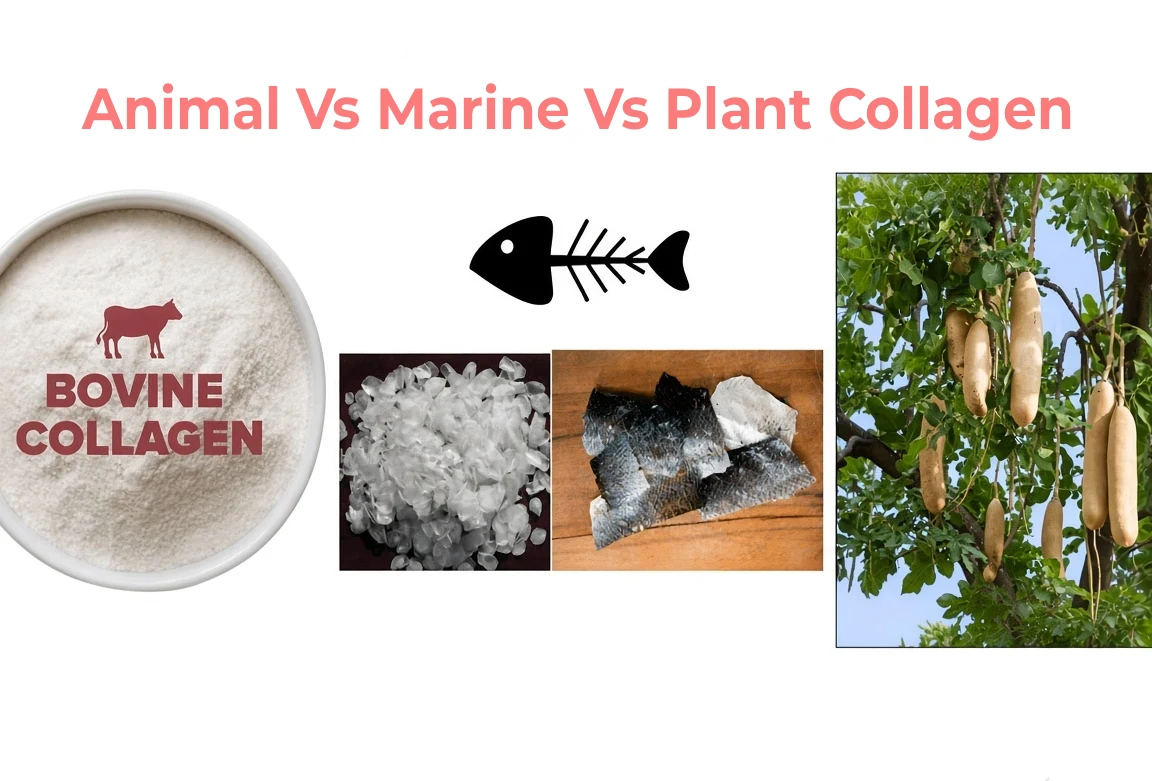
You have decided on using Collagen for your skincare – but what type? what is best for your use case – Is it Marine based Collagen or Animal derived or Plant-Based Collagen is the one to go for.
The answer lies in hydrolysis quality.
I touched on this briefly in my earlier piece, The Truth About Collagen Supplements: Science vs. Marketing Hype, but the “which source is best” question comes up so often in my clinic that it deserves its own detailed look. Usually it comes from patients confused between an imported marine sachet and a cheaper plant collagen , trying to work out whether the price difference means anything.
Sometimes it does. Often it doesn’t. Here’s how to tell the difference.
Same Protein, Different Animals
Before comparing sources, it helps to remember what doesn’t change between them. Marine, bovine, and porcine collagen are all overwhelmingly Type I collagen, the same type that makes up roughly 80% of human skin. And once any of these sources is hydrolyzed and digested, your gut breaks it into the same basic building blocks. Glycine, proline, hydroxyproline, and other amino acids.
Your body doesn’t tag an amino acid as “came from a fish” versus “came from a cow” once it’s in your bloodstream.
So the differences between sources aren’t about what they ultimately become in your body. They’re about three practical things. Peptide size going in, Amino acid ratios and other ingredients with the collagen.
Let’s take each one seriously, because the marketing around all three gets exaggerated, just in different directions.
Peptide Size and the Absorption Claim
This is the single most repeated marketing line in the category. Marine collagen absorbs better because its peptides are smaller. There’s a real mechanism behind this claim and it isn’t invented. But it’s also not the settled fact it’s presented as.
First, a quick word about the unit you’ll see on every comparison chart: the Dalton. A Dalton is simply a unit for measuring how heavy a molecule is. The smaller the number, the smaller and lighter the peptide fragment. For some perspective, a single amino acid weighs around 100 to 200 Daltons, and water weighs about 18. So when a label says its collagen peptides are “2,000 Daltons,” it’s telling you the fragments are small chains of roughly 10 to 20 amino acids linked together. The smaller those chains, the more easily they can slip through the intestinal wall and into your bloodstream.
With that in place, the numbers make sense. Commercial marine collagen peptides typically run in the range of 2,000–3,000 Daltons, while bovine peptides in less-processed forms can range higher, sometimes up to 5,000–8,000 Daltons. Smaller peptides, particularly dipeptides and tripeptides, meaning chains of just two or three amino acids, can cross the intestinal wall more directly. That’s the biological basis for the “marine absorbs faster” claim.
The degree of hydrolysis matters more than which animal the collagen came from. Hydrolysis, – is just the processing step where collagen is broken down into those small peptides in the first place.
The more thoroughly it’s done, the smaller the fragments. A bovine collagen product that’s been thoroughly hydrolyzed down to 2,000 Daltons will behave, in terms of absorption, essentially like marine collagen. Meanwhile a poorly processed marine product with larger residual peptides won’t outperform a well-processed bovine one. Source is a proxy for processing quality, not a guarantee of it.
This lines up with what shows up in the clinical trial data rather than the marketing copy. The 2023 meta-analysis of 26 randomized controlled trials – found no statistically significant difference between sources.
In plain terms, If you see “marine collagen” on a label, that alone tells you very little. What you actually want to look for is a stated molecular weight, with under 3,000 Daltons being a reasonable benchmark, or a product description of “highly hydrolyzed.” That specification matters more than the species on the front of the tub.
Amino Acid Profile: Where Sources Genuinely Differ
This is the part of the comparison that gets less marketing attention but is, to me, more interesting clinically.
Marine collagen tends to run slightly higher in glycine and proline relative to bovine sources. Bovine collagen offers a broader mix, including both Type I and Type III collagen, and carries a slightly different balance of amino acids associated with connective tissue and joint support. One reason bovine collagen is often the preferred choice in products marketed toward joint health rather than skin specifically.
Neither profile is “better” in an absolute sense. They’re just differently weighted.
For a patient whose primary concern is skin hydration and elasticity, either source has evidence behind it. For a patient asking me about joint discomfort alongside skin concerns, which comes up more than you’d expect, especially in patients also managing early osteoarthritis, I’ll usually mention that bovine-sourced products have a longer track record in the joint-health literature. Though I’ll also be upfront that this is genuinely outside my specialty, and anything beyond general skin advice is worth discussing with an orthopedist.
“Plant-Based Collagen” – The One That Needs the Most Correction
I want to repeat this clearly, because it’s the source of the most confusion I see in clinic. Plants do not produce collagen. Collagen is, definitionally, an animal structural protein. There is no such thing as a plant that contains it.
What gets sold as “plant-based collagen” or “vegan collagen” is actually a blend of nutrients. Usually vitamin C, silica, biotin, copper, and specific amino acids like glycine and proline, formulated to support your body’s own collagen synthesis rather than supply collagen itself.
Is that necessarily a waste of money? No. Vitamin C in particular is a genuinely essential cofactor in collagen synthesis, and a deficiency will absolutely impair your skin’s ability to produce collagen regardless of anything else you’re doing. But calling this category “collagen” is a labeling choice that borders on misleading, and it belongs in the same conversation as some of the more inflated claims I cover in The Biggest Skincare Scams in India.
For my vegetarian and vegan patients, my honest advice runs like this. Don’t chase a “plant collagen” product expecting it to function like animal-derived collagen peptides. Focus instead on ensuring adequate overall dietary protein and vitamin C intake. And if reducing signs of skin aging is the actual goal, prioritize the interventions with a stronger evidence base. Sunscreen and retinoids, which I detail in my retinol vs. retinoids vs. tretinoin guide.
So Which Source Should You Actually Buy?
Prioritize a stated low molecular weight, or “hydrolyzed” and “highly hydrolyzed” labeling, over the species claim itself. If skin hydration and elasticity are your main goal, either marine or well-hydrolyzed bovine collagen has reasonable trial support behind it, and the clinical literature hasn’t shown one to be reliably superior to the other.
If joint support is part of your goal alongside skin, bovine sources have a longer history in that specific research area. And if you’re vegetarian or vegan and see “plant collagen” on a shelf, understand that you’re buying a synthesis-support supplement, not actual collagen. Which isn’t necessarily bad. Just differently named than what’s on the tin.
None of this changes the bigger picture I laid out in the main collagen article. Whichever source you choose, expect a modest, gradual effect over 8–12+ weeks, not a transformation. And don’t let any collagen supplement replace your sunscreen or retinoid routine, which remain the two interventions with the strongest evidence for preserving the collagen you already have.
Dr. Shruti Patil is a board-certified dermatologist and cosmetologist at Dr. Mahajan Skin To Bone Clinic, Pashim Vihar, New Delhi. She has a particular interest in separating evidence-based skincare from wellness marketing trends, especially as they reach Indian patients through social media.
Trying to decide which supplement or skincare routine is actually worth your money? Book an appointment with Dr. Mahajan’s Clinic for a personalized, evidence-based consultation.
Leave a Reply