
The meniscus is one of the most commonly injured structures in the knee and one of the most misunderstood. Patients are frequently told they have a “torn meniscus” without fully understanding what that means for their long-term joint health, or why the treatment decision carries consequences extending decades into the future.
The choice between repairing, removing, or replacing a torn meniscus isn’t simply about relieving today’s pain. It’s a decision that directly influences your risk of developing arthritis, your need for future knee surgery, and ultimately how well your knee functions at 60, 70, and beyond.
What the Meniscus Actually Does
The meniscus consists of two C-shaped fibrocartilage structures medial (inner) and lateral (outer) sitting between your femur (thighbone) and tibia (shinbone).
Critical Functions:
- Distributes body weight across the knee joint
- Acts as a shock absorber during impact
- Improves joint stability
- Provides lubrication for cartilage surfaces
- Protects articular cartilage from excessive stress
The knee meniscus is a functional structure which protects the articular cartilage by both increasing the joint congruity and contact area, and preventing the focal concentration of stresses.
Lose meniscus tissue through injury or surgery and the remaining articular cartilage bears dramatically increased stress. This is precisely why meniscus treatment decisions matter so profoundly for long-term joint health.
Types of Meniscus Tears
Understanding tear type guides treatment decisions more than any other factor.
By Location (Vascular Zones):
Red Zone (Outer Third):
- Well-vascularized tissue
- Blood supply enables healing
- Best candidates for repair
- Higher success rates with surgical repair
Red-White Zone (Middle Third):
- Partially vascularized
- Moderate healing potential
- Some tears repairable, others not
- Surgeon judgment critical
White Zone (Inner Third):
- Avascular—no blood supply
- Cannot heal after repair
- Most tears here require removal
- Repair generally not indicated
By Pattern:
Longitudinal/Vertical Tears:
- Run along the length of the meniscus
- Bucket-handle tear: large longitudinal tear causing knee locking
- Often repairable if in vascular zone
- Common in younger athletes
Radial Tears:
- Run across the width of the meniscus
- Disrupt circumferential fibers (load-bearing function)
- Generally not repairable
- Even small radial tears can be functionally significant
Horizontal Tears:
- Divide meniscus into upper and lower layers
- Often degenerative in origin
- Repair less successful
- Partial removal often indicated
Complex/Degenerative Tears:
- Multiple tear patterns
- Associated with osteoarthritis
- Seen in middle-aged and older patients
- Conservative treatment often most appropriate
Root Tears:
- Tear at attachment point of meniscus to bone
- Dramatically increases joint stress
- Increasingly recognized as functionally devastating
- Repair strongly recommended when possible
Symptoms and Diagnosis
Common Symptoms:
- Joint line pain (inner or outer side of knee)
- Swelling (often delayed 24-48 hours after injury)
- Clicking, popping, or locking
- Giving way or instability
- Pain with squatting, pivoting, or deep knee bending
- Limited range of motion
Diagnostic Process:
Clinical Examination:
- McMurray test, Thessaly test, joint line tenderness
- Assessment of associated ligament injuries
- Evaluation of overall knee health
MRI:
- Gold standard for meniscus evaluation
- Shows tear type, location, and extent
- Identifies associated cartilage damage
- Essential for surgical planning
Important Caveat: MRI findings don’t always predict symptoms. Studies show meniscus tears on MRI in 35-40% of asymptomatic adults over 45 many tears are incidental findings, not the cause of pain.
Conservative Treatment: When to Try Non-Surgical Approaches First
Not every meniscus tear requires surgery.
Tears That Often Respond to Conservative Treatment:
- Small (<10mm) stable tears in the outer vascular zone
- Degenerative tears in patients with coexisting arthritis
- Horizontal cleavage tears in older patients
- Partial thickness tears
- Incidental tears without mechanical symptoms
Conservative Management Protocol:
- Rest and activity modification (4-6 weeks)
- Ice and compression for swelling
- Physical therapy focusing on quadriceps and hip strengthening
- Anti-inflammatory medications
- Gradual return to activity
Success Rate: Research shows 70-90% of degenerative meniscus tears in middle-aged patients respond adequately to physical therapy alone, with outcomes comparable to surgery at 1-2 year follow-up.
As detailed in our guide on knee replacement alternatives, conservative management often provides meaningful relief without surgical intervention.
When Conservative Treatment Fails:
- Persistent mechanical symptoms (locking, catching)
- Inability to return to desired activity level
- Symptoms lasting 3-6 months despite appropriate treatment
- Locked knee (bucket-handle tear causing inability to fully extend)
Surgical Options: Three Approaches Compared
When surgery becomes necessary, three options exist. The decision depends on tear characteristics, patient age, activity level, and long-term joint health goals.
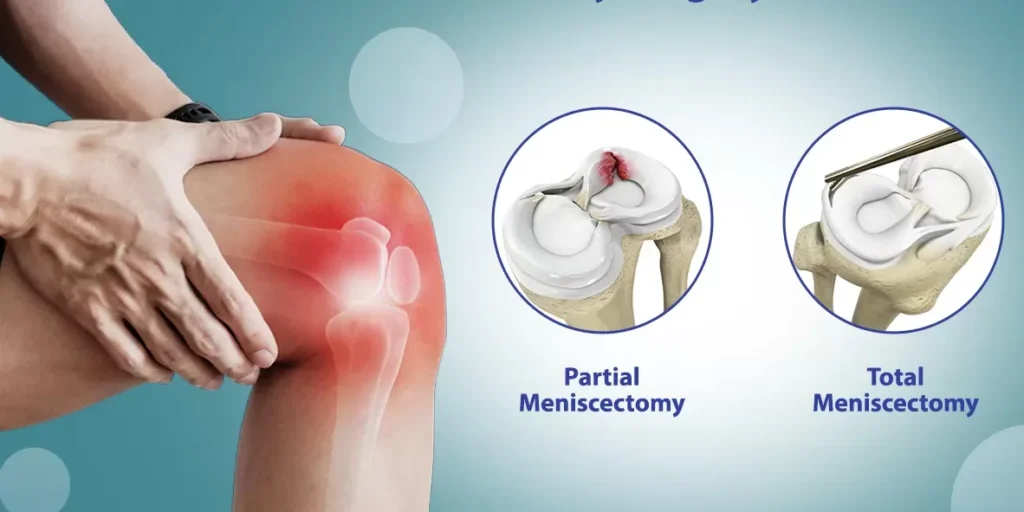
Option 1: Meniscectomy (Removal)
What It Is: Arthroscopic removal of the torn meniscus portion (partial meniscectomy) or rarely the entire meniscus (total meniscectomy). Total meniscectomy is now largely abandoned due to devastating long-term consequences.
How It’s Performed: As discussed in our comprehensive guide on arthroscopy and sports injury, this minimally invasive procedure uses a small camera and instruments through tiny incisions. The torn tissue is simply removed, leaving behind a smooth remaining meniscus edge.
Recovery:
- Return to walking: days
- Return to sports: 4-8 weeks
- Overall: fastest recovery of the three options
When Meniscectomy Is Indicated:
- White zone tears (avascular – cannot heal)
- Complex degenerative tears not amenable to repair
- Older patients with moderate-severe arthritis
- Tears with tissue quality too poor for repair
- Horizontal tears in appropriate patients
The Critical Problem: Meniscus injuries have been associated with early onset of osteoarthritis, and meniscectomy is often followed by signs of osteoarthritis.
This isn’t a minor concern. Research consistently shows:
- Partial meniscectomy increases arthritis progression significantly
- Contact stress on cartilage increases 65-235% depending on how much tissue is removed
- Risk of eventual knee replacement is substantially higher after meniscectomy
- The consequences of meniscectomy performed at a young age can lead to joint cartilage degeneration twenty years later.
The “Quick Fix” Trade-Off: Meniscectomy relieves pain quickly and effectively in the short term. The trade-off is accelerated cartilage wear over the following decades. For a 60-year-old with degenerative arthritis, this trade-off may be entirely acceptable. For a 25-year-old athlete, it may be devastating.
Option 2: Meniscus Repair
What It Is: Arthroscopic stitching of the torn meniscus back together, preserving tissue and allowing biological healing.
How It’s Performed: Through arthroscopic techniques explained in our article on arthroscopy in sports medicine, surgeons use sutures, anchors, or fixation devices to hold the torn edges together while healing occurs over 3-6 months.
Recovery:
- More demanding than meniscectomy
- Crutches 4-6 weeks
- No squatting or twisting 3-6 months
- Return to sports: 4-6 months
- Longer but more valuable long-term
When Repair Is Indicated:
Ideal Repair Candidates:
- Tear in vascular red zone (outer third)
- Younger patients (<40 years, though age alone not absolute)
- Longitudinal/vertical tears >10mm
- Acute tears (recent injury with fresh tissue)
- Bucket-handle tears causing locking
- Root tears (attachment avulsions)
- Tears associated with ACL reconstruction (repair success rates higher)
- Good tissue quality and stable tear pattern
Why ACL Reconstruction Improves Repair Success: When performed simultaneously with ACL reconstruction, meniscus repair success rates improve significantly. The biological environment created by the ACL surgery – increased blood flow and growth factors enhances meniscus healing.
Success Rates:
- Vascular zone repairs: 70-90% healing rates
- Red-white zone repairs: 50-70%
- White zone repairs: generally not attempted
- Overall: when appropriate patients are selected, excellent long-term outcomes
The Key Principle: There are few surgical options for the repair of meniscal injuries in order both to preserve the meniscus and to ensure the long-term survival of the knee joint. When repair is possible, it should be strongly preferred over removal the biological and functional preservation outweighs the more demanding recovery.
When Repair Fails: Failed repairs (10-30% depending on tear characteristics) typically require subsequent partial meniscectomy. This possibility should factor into decision-making but shouldn’t discourage repair attempts in appropriate candidates.
Option 3: Meniscus Replacement (Allograft Transplantation)
What It Is: Transplantation of a donor meniscus (from a cadaver) to replace a missing or severely damaged meniscus.
When It’s Considered:
- Previous total or near-total meniscectomy with persistent pain
- Younger patients (<50-55 years)
- Significant activity limitations after meniscus loss
- Relatively preserved articular cartilage (no bone-on-bone arthritis)
- Correct knee alignment
How It Works: Reconstruction using a meniscal allograft or synthetic substitute is used to replace the meniscus, but the biomechanical properties of the native meniscus are not reproduced entirely by the scaffolds that exist today.
This honest limitation is important: replacement meniscus tissue functions better than nothing but doesn’t fully replicate native meniscus biomechanics.
Recovery:
- Most complex of the three procedures
- Crutches 6-8 weeks
- Return to sports: 9-12 months
- Significant rehabilitation commitment
Outcomes:
- Meaningful pain reduction in 70-80% of appropriate candidates
- Slows arthritis progression compared to no meniscus
- Does not reverse existing cartilage damage
- Long-term durability still being studied
- Not a guaranteed permanent solution
Synthetic Meniscus Substitutes (CMI/Actifit): Scaffold devices allow ingrowth of new tissue into a biodegradable scaffold:
- Available in some centers
- For partial meniscus loss (not total)
- Growing evidence but still limited long-term data
- Alternative to allograft in select patients
Important Limitation: Meniscus replacement is NOT appropriate for patients with significant arthritis. Once bone-on-bone changes exist, the transplanted meniscus cannot survive or function adequately.
Decision Framework: Which Option Is Right for You?
Based on Patient Profile:
Young Active Patient (<40 years) with Acute Tear:
- Repair first priority if anatomy allows
- Preserve meniscus tissue at all costs
- Accept longer recovery for long-term benefit
Middle-Aged Patient (40-60) with Degenerative Tear:
- Conservative treatment first (3-6 months)
- If surgery needed: partial meniscectomy usually appropriate
- Repair if tear characteristics allow
- Consider overall knee health and arthritis presence
Older Patient (>60) with Degenerative Changes:
- Conservative management preferred
- Surgery if truly mechanical symptoms persist
- Partial meniscectomy generally appropriate
- Meniscus replacement rarely indicated
Previous Near-Total Meniscectomy with Pain:
- Meniscus allograft transplantation if appropriate candidate
- Must have preserved cartilage
- Age under 50-55 typically required
- High motivation for rehabilitation essential
Based on Tear Characteristics:
| Tear Type | Preferred Treatment |
|---|---|
| Acute longitudinal, red zone | Repair |
| Bucket-handle causing locking | Repair |
| Root tear | Repair |
| White zone tear | Partial meniscectomy |
| Complex degenerative | Conservative → Partial meniscectomy |
| Near-total loss, young patient | Replacement consideration |
The Overtreatment Problem
An important reality: arthroscopic meniscectomy is one of the most commonly performed orthopedic procedures worldwide and evidence suggests it’s frequently performed unnecessarily.
Multiple randomized controlled trials comparing arthroscopic partial meniscectomy to physical therapy for degenerative meniscus tears in middle-aged patients showed no significant difference in outcomes at 1-2 years.
Key Implications:
- Degenerative tears in patients over 45 with osteoarthritis often don’t need surgery
- Physical therapy should be tried first in most middle-aged patients
- Surgery for degenerative tears without mechanical symptoms (locking, catching) often doesn’t outperform conservative care
- The MRI finding of a meniscus tear doesn’t automatically indicate surgery
This doesn’t mean surgery is never appropriate—patients with true mechanical symptoms, locked knees, or failed conservative treatment benefit meaningfully. But surgery isn’t automatically the answer to every meniscus tear on MRI.
Connection to Arthritis and Future Knee Health
The long-term stakes of meniscus decisions cannot be overstated.
The Arthritis Connection:
- Meniscus loss accelerates cartilage breakdown
- The larger the meniscectomy, the greater the arthritis risk
- Even partial meniscectomy increases contact stress significantly
- Root tears left untreated cause rapid cartilage loss
Implications for Joint Replacement Timing: Patients who undergo meniscectomy particularly younger patients face a higher likelihood of eventually needing knee replacement. Understanding this timeline matters for planning and decision-making, as explored in our guides on best age for knee replacement and life after knee replacement.
Therapies that successfully repair or replace the meniscus are therefore likely to prevent or delay osteoarthritis progression.
This conclusion from published research drives the modern philosophy: preserve meniscus tissue whenever biologically and technically possible.
Post-Surgical Rehabilitation
Regardless of which surgical approach is chosen, rehabilitation significantly affects outcomes.
After Meniscectomy:
- Weight-bearing as tolerated typically immediate
- Range of motion exercises begin within days
- Quadriceps strengthening prioritized
- Return to sports: 4-8 weeks with good strength
After Repair:
- Protected weight-bearing 4-6 weeks (healing tissue must not be stressed)
- Range of motion gradually restored
- Strengthening delayed to protect repair
- Return to sports: 4-6 months
- Compliance with restrictions essential for healing success
After Replacement:
- Most demanding rehabilitation
- Extended protected weight-bearing
- Gradual return to activities over 6-12 months
- Long-term activity modifications likely necessary
Red Flags Requiring Urgent Evaluation
Seek prompt orthopedic assessment for:
- Locked knee (inability to fully straighten the knee)
- Sudden severe swelling after injury
- Complete inability to bear weight
- Giving way with walking
- Significant functional deterioration
A locked knee from a bucket-handle tear requires urgent evaluation prolonged locking can damage cartilage and make eventual repair less successful.
The Bottom Line
Meniscus treatment decisions require balancing short-term symptom relief against long-term joint preservation.
Core Principles:
- Conservative treatment first for degenerative tears surgery rarely improves outcomes over physical therapy alone for this group
- Repair over removal when biologically possible tissue preservation protects long-term joint health
- Meniscectomy when necessary some tears cannot be repaired and removal is appropriate
- Replacement for carefully selected younger patients after near-total meniscus loss
- Age and overall knee health influence every decision
The Golden Rule: Every millimeter of meniscus tissue preserved today reduces your arthritis risk tomorrow. Surgeons and patients alike should resist the temptation of the “quick fix” meniscectomy when repair is feasible the short-term recovery cost is worth the long-term joint preservation benefit.
If you’re dealing with knee pain and a suspected or confirmed meniscus tear, a thorough orthopedic evaluation is essential before committing to any treatment path. Understanding your options and the long-term implications of each empowers you to make the decision that best serves your knee health for decades to come.
Leave a Reply